Bloom
Bloom is a concept of a digital service platform that provides a safe and engaging space to cultivate emotional intelligence powered with AI.
Individual project
Cristina Tarriba
Advisor
Zach Pino
Organization
IIT Institute of Design
Date
May-August 2018

*All content in the app is from The School of Life

Still from Bloom's future version video

Painting video assets with watercolor
*All content in the app is from The School of Life
Project brief
I was challenged to explore different opportunity areas and create a new concept for a digital platform. Additionally, I was tasked to create an app prototype and visualize the future version of the concept with a video.
Results
A concept prototype for a digital systems
platform that allows people to cultivate their emotional intelligence.
-
App: Shows the present version of the platform service.
-
Video: Visualizes the future version of Bloom.
Key personal learnings
-
Prototyping with storyboards: In addition to storyboarding the video I prototyped this concept since the beginning with low fidelity storyboards. This was extremely helpful to flush out details of the concept which I had not considered before.
-
Aesthetic exploration for video storytelling: One of my favorite project of this process was to find the right aesthetic choice to visualize the concept. I explored different aesthetics and materials to create the video assets.
Opportunity space
Concept proposal
Bloom is a digital platform that provides a safe and engaging space to cultivate emotional intelligence. The app offers a highly curated library of content related to emotional intelligence, customizable learning plans and a journal to capture reflections. Additionally, it offers personalized guidance powered with AI to acquire tools to live more fulfilling lives.
Bloom
Bloom's purpose
We believe that by managing our emotions intelligently we can create a more compassionate, equitable, and healthier society. Our purpose is to foster emotional intelligence by providing a safe and engaging space where people can be inspired to learn and develop emotional intelligence tools to better navigate life.
Bloom is a concept of a digital service platform that provides a safe and engaging space to cultivate emotional intelligence powered with AI.

How it works
*All content in the app is from The School of Life
Still from Bloom's future version video
Painting video assets with watercolor
*All content in the app is from The School of Life
CFPAC
(Chicago Food Policy Action Council)
Enabling food entrepreneurs to navigate the complex food licensing system in Chicago
Team
Cristina Tarriba, Goen Lee,
Divya Iyengar, Vidya Mantrala.
Advisor
Tomoko Ichikawa
Organization
CFPAC + IIT Institute of Design
Date
Aug - Dec 2018


Project brief
In partnership with the Chicago Food Policy Action Council (CFPAC), we were tasked to create visualizations of the food licensing, permitting and certification processes to help food entrepreneurs navigate the complex system in order to start, run, and grow their business in Chicago.
Problem
Currently, the process that food entrepreneurs in Chicago have to go through in order to obtain the appropriate licenses and certifications to start and run their businesses is highly complex. The information to get a license or certification is available online, however, it is mainly text-based, dense, and unclear.
My role
I developed research protocols, conducted stakeholder interviews, and helped distill the information into a visual structure of the shared kitchen license map and the city market permit map.
Results
As a class, we managed to convert text-based information of licensing and permit processes into graphical representations with the purpose of helping food entrepreneurs better navigate the complex system. 10 different licensing processes for food entrepreneurs were converted into graphical representations.
Key personal learnings
-
Being bilingual allowed me to understand what people were saying but more importantly what they meant: As the only Spanish speaking member in the team, I interviewed people who only spoke Spanish and translated back to the rest of the team. This not only meant sharing in English what we talked about in our interviews but it meant explaining and unpacking cultural nuances. This experience was very powerful for me because it represented an opportunity for me to be an advocate for an unrepresented community (Latin street vendors in Chicago).
Design process

+
+
+
+
Research Secondary + stakeholder interviews
Secondary research
We gathered examples of other cities that have worked on similar projects. We looked at all of the materials offered by the Business Affairs and Consumer Protection (BACP) website. The information gathered at this point helped us create our first prototypes of the license maps.
Research planning
I helped develop research protocols that were composed by an interview guide as well as
additional activities to get understand more
deeply their experience.
Stakeholder interviews
I interviewed two consultants and talked to the members of the street vendors association to introduced the project and asked for additional interviews. Overall we conducted interviews with different participants of the ecosystem (city officials, consultants, food entrepreneurs, etc).


Picture taken at SVA (Street vendors association)
Key findings on food businesses licensing process in Chicago
-
The process is complicated and rather than being a path it involves many processes.
-
To become a food entrepreneur you often require multiple licenses, each with its own prerequisite certificates and permits.
-
The food business licensing process in Chicago involves interacting with not just one government entity, but probably many of them. Each of them requiring different ways of interacting and submitting documents and information.
-
The business licensing process is constantly changing the rules and requirements for various licenses and it's hard for the city staff to keep up to date.
-
For food entrepreneurs, it is hard to identify which type of license and permits they need in order to move forward with their business.
-
The process does not begin with a simple decision, but rather a complex set of decisions based on multiple business variables.
Prototyping Changing the shape of information


-
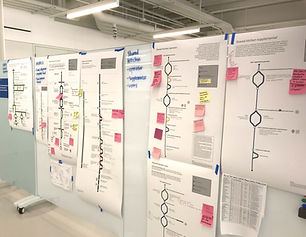
Identifying and exploring different forms of representing the text-based information: With the information available online on BACP we analyzed the current materials for getting food licenses and permits.
-
At this point, we took a stab at identifying diagrammatical forms for this dense text-based information, with the hope of creating a visual structure that would help food entrepreneurs better understand the process.
-
Developing a common visual language to indicate different types of information across all licenses and permits (departments, actions, understand expectations, etc).
-
We created suggestions for a visual language with its own semantics and syntax to help people better navigate these processes.
-
Incorporating feedback from different stakeholders: We shared our first version of prototypes to different stakeholders (city officials, consultants, and food entrepreneurs) to identify misalignments in the information between stakeholders and gaps of information.
-
We were able to capture their feedback and incorporate this into our following iteration. We did the same exercise a couple of times to make sure we were capturing the process as truthfully as it happens in reality.
Relationship map Interactions between entities
A snapshot of the world of starting a new food business in Chicago
We created a visual snapshot model of the world of starting a new food business in Chicago. It shows the existing entities involved (government officials, consultants, and support organizations and business owners) in the licensing process of the food business ecosystem and exposed the relationships
between them.
Mapping out the complex landscape of relationships between food business entities
in Chicago
In the Chicago food business landscape complex interactions between entities are taking place as well as an exchange of information flows. the following model captures these interactions considering three different perspectives: Business owners, government officials’ and consultants.


Sharing our cart vendor license map to SVA (street vendors association) member.
Final presenation
We presented our maps and insights to members of the Chicago Food Policy Action Council as well as different business owners, city officials, and consultants.
This session was a set of multiple conversations where we discussed the licenses and permit maps, the relationships between entities, and the insights that were shaped into design factors and principles to consider for future decisions.